
Part one · the catalogue
Three calculators and one search box
These three run inside your own browser: no upload, no storage, no account needed. Nor is any figure here a quote. The only binding numbers are the ones in your Tomebuy account at the moment you pay.
Using the three tools here
How to use the calculators here, in one line each: they answer the three questions that come up in the same order every time. What will this cost me in my own currency? Why is the freight higher than the weight suggests? How long have I got before something expires? Each one is deliberately plain: you type what you know, and it shows the arithmetic rather than hiding it.
Two things they cannot do. They cannot quote freight, because Tomebuy publishes no public rate table and the figures in its public route data look like demonstration values rather than real prices. Nor can any tool here say what customs will want, since that turns on where you live, what value is declared and whether anyone opens the box.
Landed cost: the number people underestimate
First-time buyers price the goods and forget the two charges that arrive later. The builder below keeps them in view. Goods price and seller postage are what you pay at checkout. Freight is quoted when you submit the parcel. The parcel charge of about RMB 8 appears on both the fee page and the help centre, though the two call it different things.
The conversion box starts at the figures Tomebuy held in its own settings when we read them: 6.5 yuan per dollar, 7.5 per euro, 8.6 per pound. Those are not market rates and Tomebuy does not explain them, so change the number to whatever your bank is actually giving you and compare the two totals. More on the rate.
Chargeable weight: the box can beat the scale
A duvet weighs little and fills a car boot. Carriers price that with volume weight: the box dimensions multiplied together and divided by a number the carrier chooses. Tomebuy's help centre lists four possible divisors, 5,000 through 8,000, and adds that not every line bills this way at all. The checker shows both weights so you can see which one would decide the price.
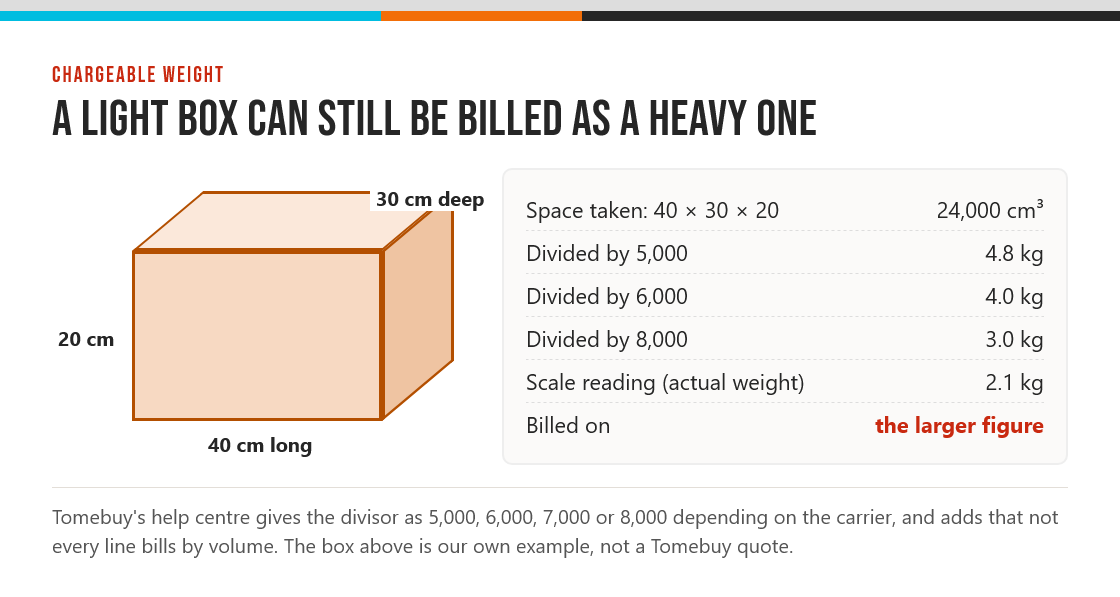
Use this comparison to discuss packing with the warehouse. For a hypothetical 40 × 30 × 20 cm carton at 2.1 kg, divisor 8,000 gives 3 kg by volume. Reducing height to 12 cm gives 1.8 kg by volume, so the 2.1 kg scale weight would lead. That is a weight comparison, not permission to remove necessary protection; read route and packing limits first.
Dates: five deadlines from one day
The day your goods reach stored status starts several clocks at once, and they are not the same length. The return request window is five days. The exchange window in the help centre is fourteen. Free storage is sixty, ninety or one hundred and eighty days depending on which Tomebuy page you read, which is why the tool shows all three rather than choosing.
Put the sixty-day date in your calendar, not the longest one. If the shortest figure turns out to be the one the warehouse applies, you lose nothing by having shipped early. If you plan around the longest and it is wrong, the goods are gone. The three answers, with their pages.
Getting more from the search box
The box at the top of every page searches the product catalogue by text. It is a word match, not an image match, so it rewards describing the thing: ribbed knit cardigan finds more than a maker name does. If you have a photo instead of words, Tomebuy's own search field accepts an uploaded image, and its guidance is to use a picture with a clean background.
Word searches worth tryingWhy freight is quoted twiceStorage and returns in full