
Part three · reference
Fees, payments and what the currency switch costs
What you actually pay, in the order the money leaves your account, and the one figure Tomebuy sets itself without explaining.
The cost breakdown, line by line
The official fee page puts it in one line. Three things make up the bill: what the goods cost, what the international leg costs, and whatever customs asks for. The first of those already includes the seller's delivery across China. No commission is taken and no handling fee is added; anything else on the invoice is an extra you asked for.
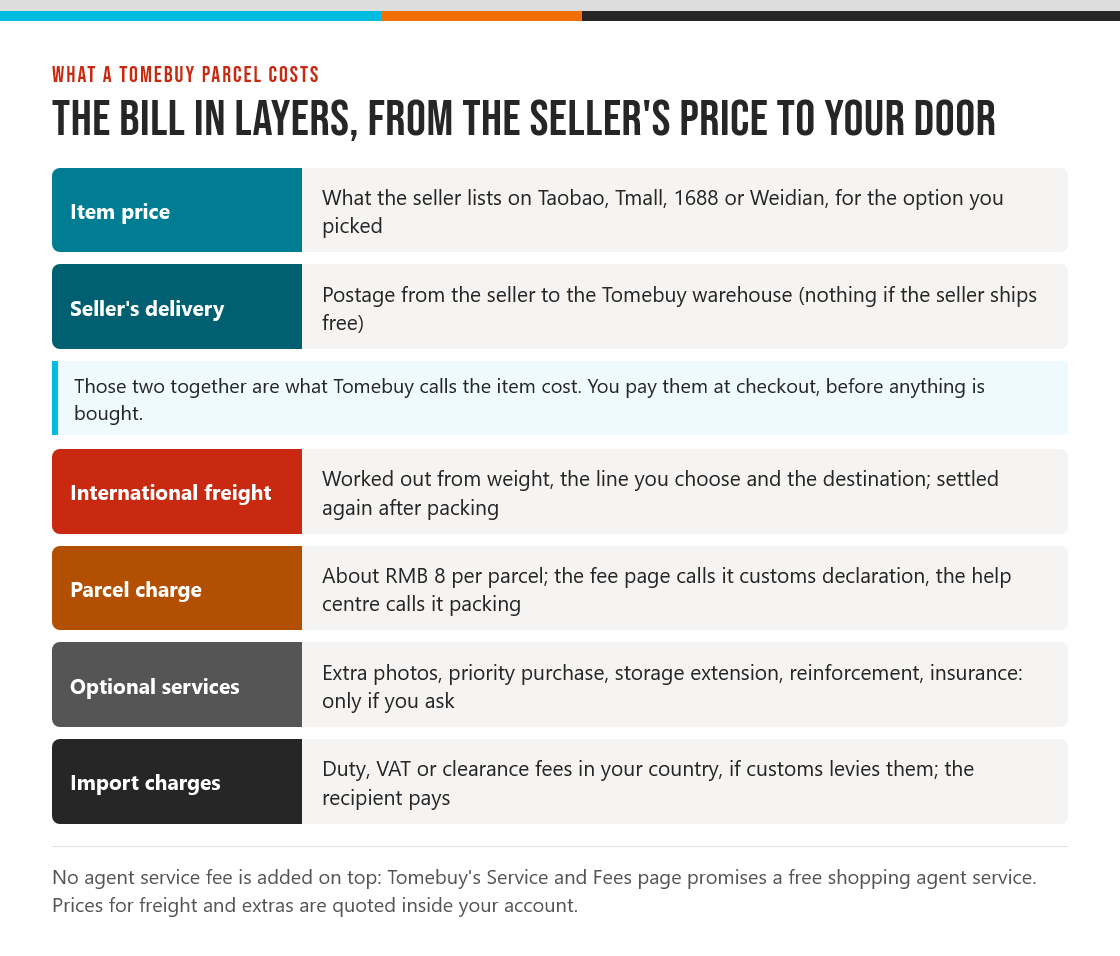
That gives six possible lines on one order, and you will not see them all at once:
| Line | When you pay it | How it is set |
|---|---|---|
| Product price | At checkout | The seller's price for the option you chose |
| Seller's delivery in China | At checkout | The seller's charge; nothing if they ship free |
| International freight | When you submit the parcel | Weight, route and destination |
| Parcel charge, about RMB 8 | With freight | Per parcel, not per item |
| Optional services | When you request them | Per photo, per order or per parcel |
| Duty, tax or clearance | On arrival, if charged | Your country's rules; the recipient pays |
Buying several things from one seller in a single order means the domestic delivery is charged once rather than per item. It is the cheapest saving available on this whole route and it costs nothing but a little planning.
The RMB 8 charge, and why it has three names
One small charge appears under three descriptions on three official pages. The fee page calls it a customs declaration cost of about RMB 8 for a parcel, varying with the shipping method. The help centre, answering how agent purchasing is priced, calls the same figure a packaging consumables fee. The international transit pricing answer calls it a packing fee of 8 yuan per parcel.
The amount agrees in all three places, so the practical answer is unaffected: budget about RMB 8 for every parcel you send, however it is labelled on the invoice. We record the discrepancy because a reader who sees two different names for one charge reasonably wonders whether they are being billed twice. Errata entry.
Optional services, and when they are worth it
The value-added list covers personalised photographs, priority purchasing, storage extension, reinforcement for fragile goods, parcel photos, pre-packing and vacuum packing. Prices are listed inside the account; the figures exposed in the site's public data look like demonstration values rather than live prices, so we do not reprint them here.
Which ones earn their keep:
- A measured photograph is the one we would buy every time for clothing and shoes. A tape against a garment answers the only question the free photos cannot.
- Vacuum packing pays for itself on bulky soft goods, because it attacks the volume weight rather than the scale weight. Check both first.
- Reinforcement is for ceramics, glass and anything with a screen. It adds bulk, so on a light fragile item it can push you into a higher volume bracket.
- Priority purchasing matters when stock is moving fast and not otherwise.
- Storage extension is bought before the free period expires, never after.
To request any of them, leave the order number in the notes when you buy the service, in the format the help centre describes. A service bought without a reference cannot be matched to your goods.
Cards, balance, and getting a balance out
International cards are handled through a card channel provided by PayPal. Beyond that, the published detail is thin: there is no full list of accepted methods on the site, and the recharge instructions speak in yuan, which tells you the account balance is denominated in CNY whatever you paid with.
A balance is worth keeping for one reason: the freight you pay at submission is provisional, and the difference after packing comes out of the balance automatically. An empty balance turns a two-yuan shortfall into a parcel sitting on a shelf.
Money can be withdrawn from the balance back to the original payment account through the user centre. Tomebuy quotes ten to fifteen working days and warns that the bank side can stretch that to twenty-five. Treat the balance as money committed to this hobby rather than as savings.
Yuan into your currency, and the margin inside it
Prices on the marketplaces are in yuan. Tomebuy displays totals in your chosen currency using rates held in its own settings. When we read them on 21 October 2026 they were fixed figures: 6.5 yuan per US dollar, 7.5 per euro, 8.6 per pound. No page explains how they are set or how often they change.
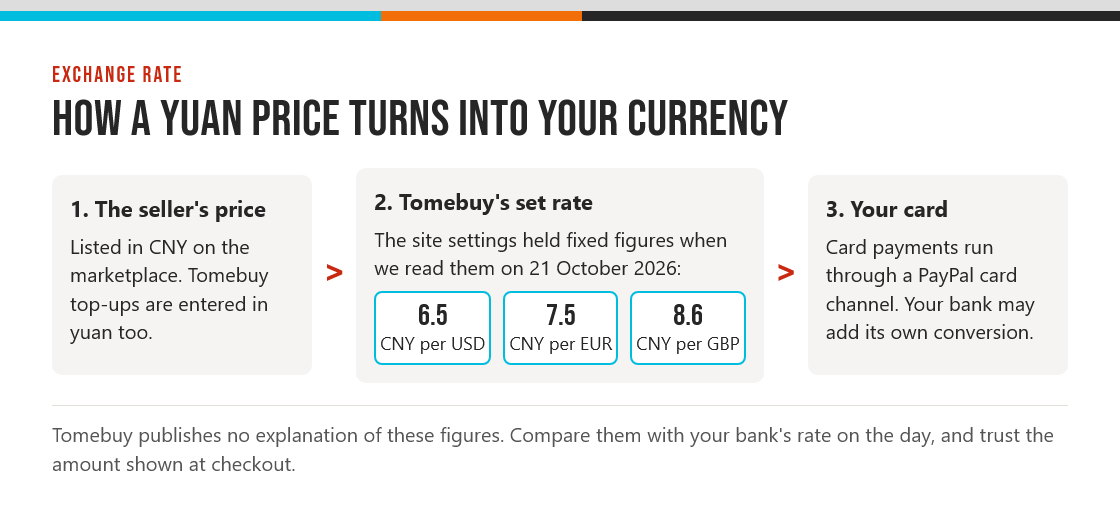
Compare those against whatever your bank is quoting on the day. A site rate below the market rate makes the displayed foreign-currency price higher than a straight conversion would be; the gap is the margin. It is not hidden, exactly, but it is not announced either, and on a large order it is worth more than most of the optional services cost.
Your card issuer may add a second conversion on top, since the charge passes through a card channel. The figure that binds is the one shown at the moment you confirm payment.
Build the total yourselfHow freight is calculatedWhere the pages disagree