
Part three · reference
Shipping, weight and customs
How the freight price is built, why it changes after you pay it, and what happens at the border. No route prices appear on this page, and the reason is at the bottom.
Chargeable weight: scale against box
Every international price starts from one number, and it is not necessarily what the scale says. Carriers work out a second weight from the size of the box and bill on whichever figure is larger. The help centre sets out the sum plainly enough: take the box in centimetres, side by side by side, and divide the result by whichever figure the carrier uses, 5,000 through 8,000. It adds that plenty of routes never price this way at all.
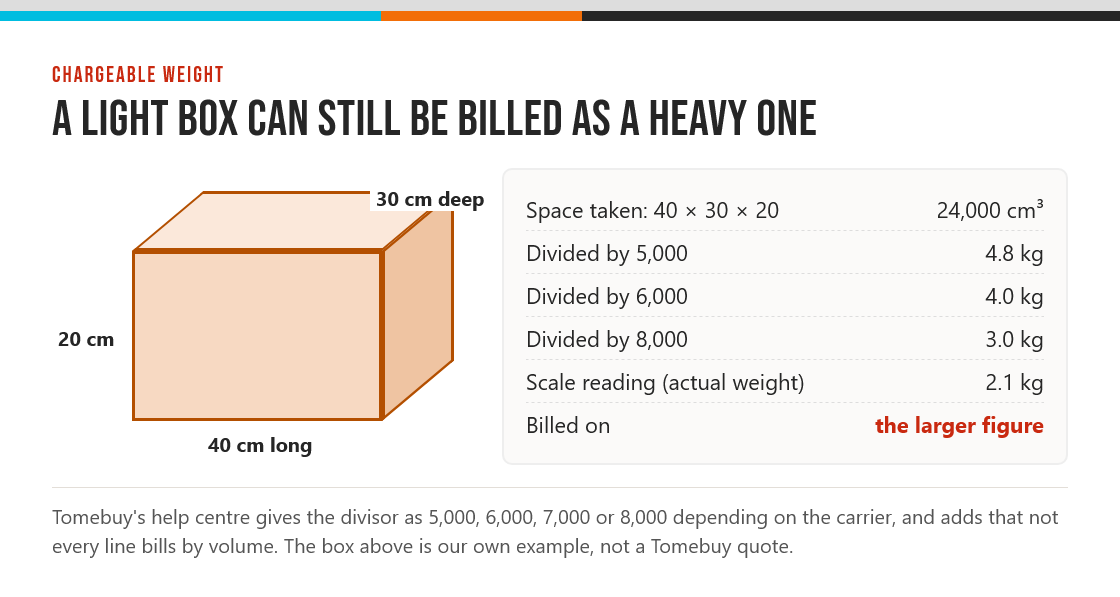
The consequence is that padding, boxes and air are all things you pay for. It is also why the number changes between stop six and stop seven of an order: you pay first on the weight recorded when the goods were shelved, and the warehouse recalculates on the finished parcel. Overpayments return to your balance, shortfalls come out of it.
Combining parcels, and the point where it stops helping
Most routes price a first weight step and then each further step, plus a per-parcel charge. Three parcels therefore pay three first steps and three parcel charges; one combined parcel pays one of each. Tomebuy's packaging page works a US example through this arithmetic and the saving is large.
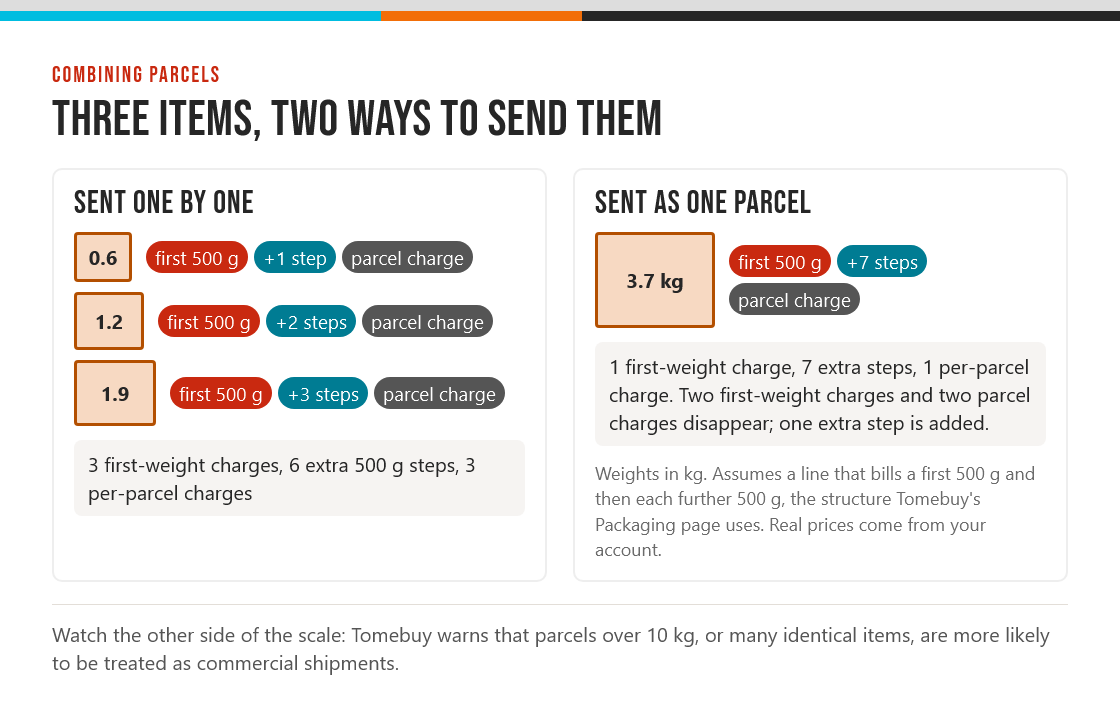
The limit is customs, not arithmetic. Tomebuy flags two triggers for a parcel being treated as commercial rather than personal: weight above ten kilograms, and several identical items in one box. A commercial classification can mean duty, paperwork, or a refusal. Two medium parcels can be cheaper than one large one once that risk is priced in.
Our rule of thumb: combine freely up to a handful of kilograms, split anything that would cross ten, and never put six of the same thing in one box.
What travels badly
The prohibited list is the usual one: weapons, explosives, flammables, corrosives, radioactive and toxic materials, narcotics, currency, obscene material, live animals, perishables and anything that endangers the people handling it. Those are refused outright.
The more useful list is the restricted one, the goods that can travel but only on some routes, and it is where first orders come unstuck:
- Anything with a battery, including shoes that light up and headphones.
- Liquids, creams and powders, which includes perfume and most cosmetics.
- Magnets, common in phone cases and bag closures.
- Aerosols and pressurised containers of any size.
- Large or heavy single pieces, which some routes refuse by dimension.
The warehouse flags these when you select items for a parcel: restricted goods simply do not appear on routes that will not carry them. Checking before you buy is cheaper than discovering it with the goods already shelved.
Customs, declarations and who pays
Tomebuy's customs page divides the subject into risk factors and declaration choices, and is unusually frank about both. The system flags risky items during ordering, and the warehouse recommends a lower-risk route based on what the goods are. It states that inspections are unpredictable, that heavy parcels and high declared values attract attention, and that many identical items raise scrutiny.
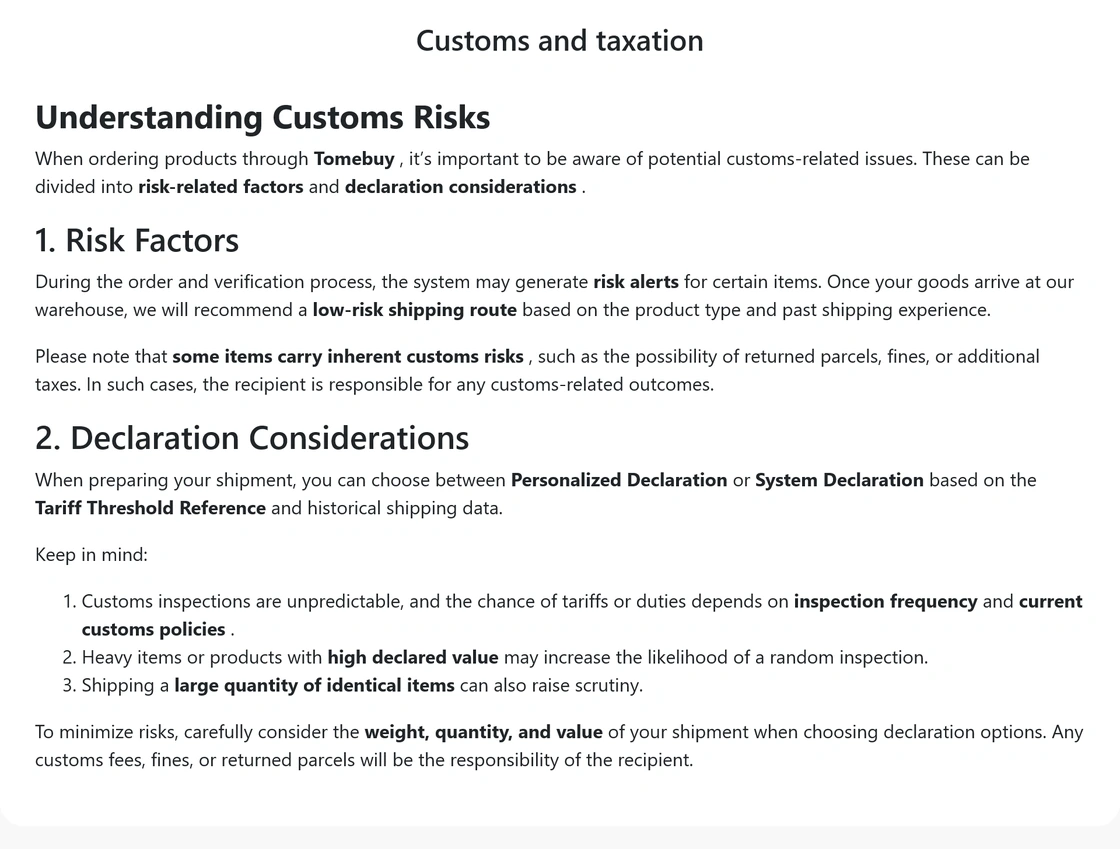
When submitting, you choose between a personalised declaration and a system declaration. Whichever you pick, the stated position is that any duty, fine or returned parcel is the recipient's responsibility. For purchased goods, Tomebuy says it can provide a screenshot of the payment record if clearance asks for proof, but not a formal invoice.
For the European Union, Tomebuy says it has registered an IOSS number and plans routes around each carrier's requirements. Postal and commercial express channels both run, with duties collected from the recipient on arrival under the usual model. If your country's rules changed recently, trust your own customs authority over any agent's summary, including this one.
Why there are no route prices here
Tomebuy publishes no public freight calculator. The route data its own site exposes is internally inconsistent: a well-known express service appears with a first-half-kilogram price of five, another at one, and the route notes are in Chinese even in the English fields. Those read as demonstration values left in during setup rather than live prices, and the quotation endpoint returns an error to anyone outside the account.
Printing numbers like that would be worse than printing none, because a reader would plan around them. So this edition describes the method and leaves the figures to the only place they are real: the route list that appears when you submit a parcel, with your actual weight and your actual destination. The home page claim of more than 150 routes is the company's own, and we have no way to count them.
Chargeable weight checkerThe rest of the billBefore the parcel goes